
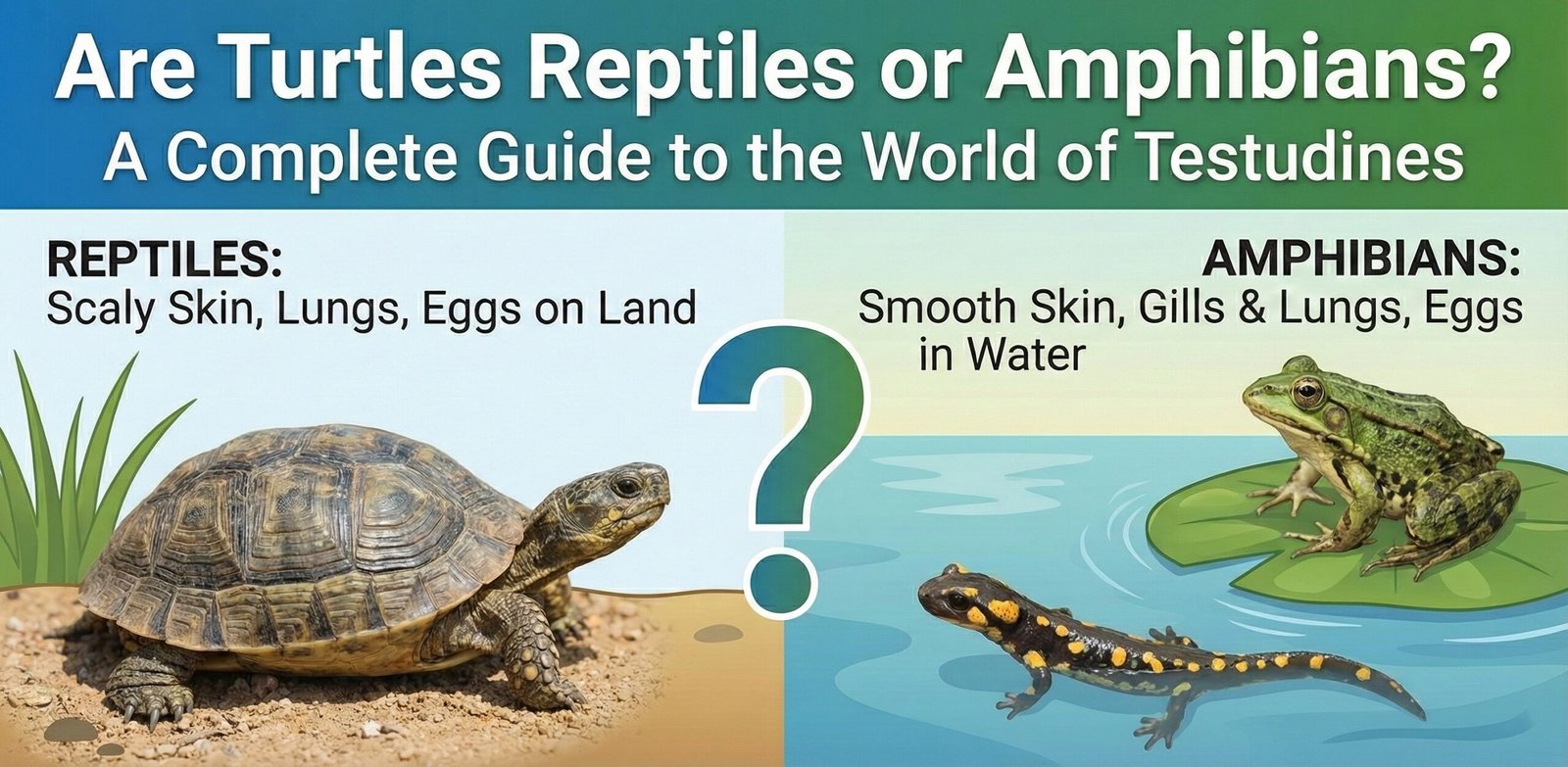
The natural world is full of fascinating creatures that often defy our first impressions. Among the most misunderstood are turtles. Because they spend a significant portion of their lives in ponds, rivers, and the vast open ocean, many people from curious students to new pet owners find themselves asking the same question: Are turtles reptiles or amphibians? At first glance, the confusion is understandable. Like frogs (which are amphibians), many turtles are semi-aquatic. However, in the world of biological classification, the answer is definitive. Turtles are reptiles. They belong to an ancient and resilient group of animals that have outlived the dinosaurs, adapting to almost every environment on Earth.
In this deep dive, we will explore the scientific reasons behind this classification, compare turtles to their amphibian counterparts, and look at what makes these shelled vertebrates some of the most cool reptile pets for dedicated enthusiasts.
The Scientific Classification: Understanding Testudines

To understand why a turtle is a reptile, we must look at its “family tree.” Turtles belong to the order Testudines. This group includes all living turtles, tortoises, and terrapins.
As vertebrates, turtles possess a complex skeletal system, but they are unique because their ribcage has evolved into a protective shell. This biological “armor” is part of their spine, meaning a turtle can never “crawl out” of its shell as depicted in cartoons.
The Reptilian Checklist
Biologists use specific criteria to classify an animal as a reptile. Turtles check every single box:
- Amniotic Eggs: They lay eggs with a leathery or hard shell on land.
- Lungs: They breathe air from birth to death.
- Scaly Skin:A protective layer of keratin-based scales or scutes covers their skin.
- Ectothermic: They are cold-blooded, relying on the sun to regulate their body temperature.
Why Turtles are Reptiles (and Not Amphibians)

While amphibians like frogs and salamanders require moisture to survive and often have a “double life” (starting in water with gills and moving to land with lungs), turtles are strictly terrestrial or aquatic air-breathers.
Respiration: The Lung Factor
Unlike amphibians, which can often breathe through their porous skin, turtles have tough, impermeable skin. From the moment a turtle hatches from its egg, it uses lungs to breathe. Even sea turtles, which can stay submerged for hours, must eventually return to the surface to take a gulp of air.
The Egg and the Land
The most significant “fact about reptiles” is their independence from water for reproduction. Amphibians lay jelly like eggs in the water if those eggs dry out, they die. Turtles, however, lay amniotic eggs. These eggs have a protective shell that keeps the embryo moist while allowing oxygen to pass through. Remarkably, even the most aquatic sea turtles will travel thousands of miles to return to a beach to bury their eggs in the sand.
Skin Texture and Moisture
Amphibians have “permeable” skin, meaning liquid and gas can pass through it. This is why a frog feels slimy or wet. Turtles have dry, scaly skin. Their scales (and the scutes on their shell) are made of keratin the same protein found in human fingernails. This allows them to live in dry deserts or salty oceans without losing their internal body fluids.
Comparison Table: Turtles vs. Frogs
To help visualize the differences between the two classes, let’s look at this comparison between turtles vs frogs:
| Feature | Turtles (Reptiles) | Frogs (Amphibians) |
| Scientific Class | Reptilia | Amphibia |
| Skin Type | Dry, scaly, and hard | Smooth, moist, and permeable |
| Breathing | Lungs (from birth) | Gills (larvae), Lungs/Skin (adults) |
| Egg Structure | Hard or leathery shell | Jelly-like, no shell |
| Metamorphosis | No (Hatch as miniature adults) | Yes (Tadpole to Frog) |
| Habitat | Land, Freshwater, or Saltwater | Moist land or Freshwater only |
The Turtle Shell: A Marvel of Engineering
One cannot discuss the Testudines order without focusing on the shell. The shell is not just a house; it is a part of the turtle’s body. It consists of two main parts
- The Carapace: The top, rounded part.
- The Plastron: The flat, bottom part.
These two pieces are joined by “bridges” on the sides. Because turtles are cold-blooded, their shells are excellent for absorbing heat from the sun. If you see a turtle sitting on a log in a pond, it isn’t just resting it is “basking” to speed up its metabolism and digestion.
Turtles as Cool Reptile Pets: What You Should Know

In 2026, the trend of keeping reptiles has shifted toward “sustainable and responsible” ownership. Turtles are often cited as cool reptile pets because of their personality and ancient appearance, but they require significant commitment.
Why They Make Great Pets:
- Longevity: Many species live 30 to 50 years, making them lifelong companions.
- Observation: They are fascinating to watch, especially during feeding time.
- No Fur: Ideal for pet lovers with allergies to cats or dogs.
The Challenges:
- Habitat Needs: Most turtles need a “stock tank” or a large aquarium with both swimming space and a dry basking area.
- UV Lighting: They require UVB light to process calcium; without it, their shells become soft and deformed.
- Salmonella: It is a well-known fact about reptiles that they can carry Salmonella bacteria. Hand washing after handling is a must.
Fascinating Fact About Reptiles: Did You Know?

- Temperature-Dependent Sex Determination (TSD): For many turtles, the gender of the hatchlings is decided by the temperature of the sand. Warmer sand usually produces females, while cooler sand produces males.
- Ancient Lineage: Turtles have been on Earth for over 200 million years. They saw the rise and fall of the T-Rex!
- Butt-Breathers: Some species of hibernating turtles can absorb oxygen through their cloaca (the tail end) while underwater in winter. This is a survival mechanism called “cloacal respiration.”
Conservation in 2026: The Future of Turtles
As we move further into the 21st century, turtles face unprecedented threats. Climate change is warming nesting beaches, causing an imbalance in male-to-female ratios. Furthermore, plastic pollution in the oceans is often mistaken for jellyfish a favorite food for sea turtles.
Protecting these vertebrates is essential for our ecosystem. Turtles help maintain healthy seagrass beds and coral reefs, and land tortoises help disperse seeds for forest growth.
Frequently Asked Questions
Is a sea turtle an amphibian?
No. Even though sea turtles spend 99% of their lives in the ocean, they are reptiles. Air-breathing is a necessity for them, and they are obligated to lay their eggs on dry land.
Can a turtle live without its shell?
Absolutely not. The shell is fused to the turtle’s ribcage and spine. It is a permanent, living part of their body that grows with them.
What is the main difference in turtles vs frogs?
The main difference is their life cycle. Frogs undergo metamorphosis (changing from a water-breathing tadpole to an air-breathing frog), whereas turtles hatch as fully formed, air-breathing miniature versions of their parents.
Conclusion

So, are turtles reptiles or amphibians? As we have explored, their dry scales, lung-based breathing, and amniotic eggs place them firmly in the reptile category. Whether they are swimming in the deep ocean or basking on a backyard log, these members of the Testudines order are a testament to nature’s ability to create durable, long-lasting life.
If you are considering adding one of these cool reptile pets to your family, remember that you aren’t just getting a pet; you are becoming a guardian of an ancient lineage. Proper care, respect for their biology, and an understanding of their needs will ensure these incredible vertebrates continue to thrive for another 200 million years.